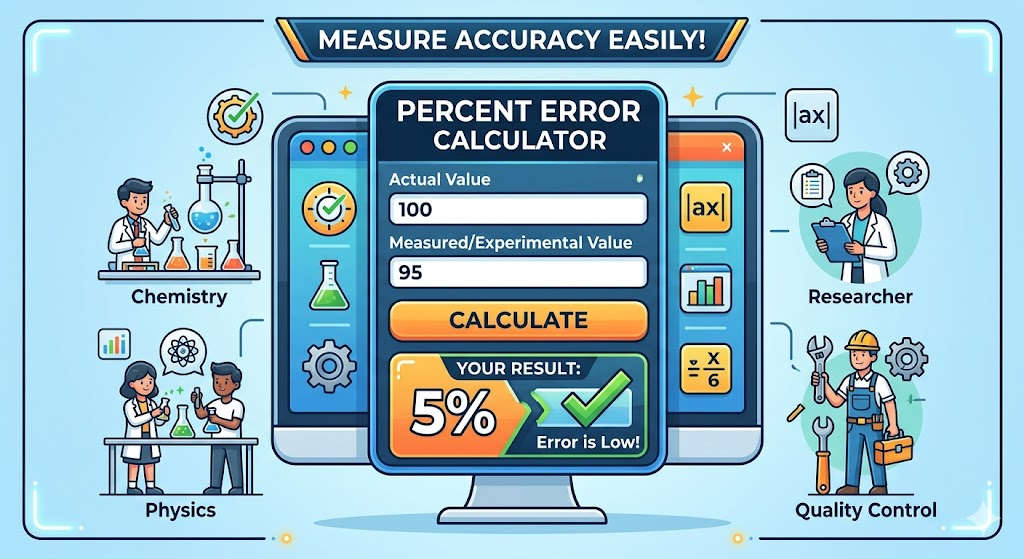
Percent Error Calculator
A percent error calculator helps students, teachers, scientists, and researchers measure the accuracy of results. It compares an estimated value with an actual value and shows the difference as a percentage. Many people use a percent error calculator in science labs, school assignments, engineering work, and research projects.
A percent error calculator saves time and reduces mistakes during calculations. Instead of solving long formulas manually, users can enter values and receive instant results. This makes learning easier and helps users understand how close their answers are to the correct value.
Students often use a percent error calculator during chemistry and physics experiments. Teachers also recommend it because it helps explain the accuracy of measurements in a simple way. Scientists and engineers rely on percent error calculations to improve testing and reduce errors in experiments.
Understanding percent error is important because no experiment or measurement is perfect. Small differences happen due to human mistakes, machine limits, or environmental conditions. A percent error calculator helps measure these differences clearly.
Many online tools now provide quick percent error calculations. Some calculators also explain the steps, which helps students learn the formula easily. A percent error calculator is useful for anyone who wants accurate and reliable results without difficult math.
What Is a Percent Error Calculator
A percent error calculator is an online tool that measures how far an estimated value is from the actual value. The result appears as a percentage. This percentage shows the size of the error compared to the correct value.
The calculator uses two main values:
| Value Type | Meaning |
| Experimental Value | Measured or estimated value |
| Actual Value | Correct or accepted value |
The percent error calculator compares these values using a simple formula. If the percent error is small, the result is close to the correct answer. If the percent error is large, the result is less accurate.
Students commonly use a percent error calculator in chemistry experiments. For example, a student may measure the boiling point of water during a lab test. If the measured value differs from the accepted value, the calculator shows the percent error.
Businesses and factories also use percent error calculations for quality control. They compare expected product measurements with actual results to improve production accuracy.
A percent error calculator makes this process quick and easy. Users no longer need to perform every step manually. The calculator gives fast answers and reduces calculation mistakes.
How a Percent Error Calculator Works
A percent error calculator works by comparing the difference between two numbers. It calculates how large the difference is compared to the actual value.
The calculator follows a standard formula used in science and mathematics.
\text{Percent Error} = \left(\frac{|\text{Experimental Value} – \text{Actual Value}|}{\text{Actual Value}}\right) \times 100
The calculator first subtracts the actual value from the experimental value. Then it divides the difference by the actual value. Finally, it multiplies the answer by 100 to get the percentage.
Here is a simple example:
| Step | Example |
| Actual value | 50 |
| Experimental value | 47 |
| Difference | 3 |
| Divide by actual value | 3 ÷ 50 |
| Multiply by 100 | 6% |
In this example, the percent error is 6%.
A percent error calculator performs these steps instantly. Users only need to enter the values into the calculator fields.
Many calculators also display step-by-step solutions. This helps students understand the process instead of only seeing the final answer.
Why Students Use a Percent Error Calculator
Students often use a percent error calculator because science and math experiments require accurate measurements. Manual calculations can feel confusing, especially for beginners. A calculator makes the process easier and faster.
A percent error calculator helps students:
| Benefit | Explanation |
| Save time | Instant calculations |
| Reduce mistakes | Accurate formulas |
| Learn formulas | Step-by-step solutions |
| Improve understanding | Clear comparison of values |
| Prepare assignments | Faster homework completion |
Many science teachers ask students to calculate percent error after lab experiments. Students compare measured results with accepted scientific values.
For example, chemistry students may calculate the percent error for density, temperature, or mass measurements. Physics students often use percent error during motion and force experiments.
A percent error calculator also builds confidence. Students can quickly check whether their calculations are correct before submitting assignments.
Online calculators are especially helpful during exam preparation. Students can practice multiple questions in less time and improve problem-solving speed.
Importance of Percent Error in Science
A percent error calculator plays an important role in science because experiments rarely produce perfect results. Every experiment contains small differences caused by tools, methods, or environmental changes.
Scientists use percent error to measure the reliability of results. A low percent error usually means the experiment produced accurate data. A high percent error may show problems with equipment or measurement methods.
Here is why percent error matters in science:
| Scientific Purpose | Reason |
| Accuracy checking | Measures closeness to correct value |
| Experiment improvement | Finds mistakes in methods |
| Quality control | Improves testing standards |
| Data comparison | Compares different results |
| Research reliability | Supports better conclusions |
A percent error calculator helps scientists work faster and avoid manual mistakes. Laboratories often use digital systems to calculate percent error automatically.
Students also learn scientific thinking through percent error calculations. They understand that errors are normal in experiments and that careful measurements improve results.
A percent error calculator makes these lessons easier to understand because the results appear instantly and clearly.
Difference Between Percent Error and Percent Difference
Many people confuse percent error with percent difference. However, they are not the same. A percent error calculator compares an estimated value with a correct value. Percent difference compares two measured values.
Here is a simple comparison table:
| Percent Error | Percent Difference |
| Uses actual value | Uses average of values |
| Measures accuracy | Measures variation |
| Common in science labs | Common in data comparison |
| Needs accepted value | No accepted value needed |
A percent error calculator works only when there is a known correct value. For example, the accepted boiling point of water is 100°C at standard pressure.
Percent difference works differently because neither value is considered fully correct. It simply measures how far apart the numbers are.
Students should understand this difference clearly because teachers often ask separate questions about both formulas.
Using the correct formula helps avoid mistakes during assignments and exams.
Common Causes of Percent Error
A percent error calculator shows how much error exists, but understanding the causes of that error is also important.
Errors can happen for many reasons during experiments or measurements.
Here are common causes of percent error:
| Cause | Explanation |
| Human mistakes | Reading numbers incorrectly |
| Tool problems | Faulty measuring equipment |
| Environmental changes | Temperature or pressure changes |
| Calculation errors | Wrong formulas or math mistakes |
| Recording mistakes | Writing incorrect values |
For example, a student may accidentally read a ruler from the wrong angle. This small mistake can change the final answer.
Machines and instruments also have limits. Even advanced equipment may produce slight variations during testing.
A percent error calculator helps users notice these problems quickly. If the percent error is very high, users know they should review the experiment carefully.
Understanding the causes of error improves future accuracy and helps students learn better scientific methods.
How to Calculate Percent Error Manually
Although a percent error calculator makes calculations easier, students should still know how to solve percent error manually.
The process is simple when followed step by step.
First, subtract the actual value from the experimental value. Use the absolute value so the answer stays positive.
Second, divide the difference by the actual value.
Third, multiply the result by 100.
Here is an example:
| Step | Value |
| Actual value | 80 |
| Experimental value | 76 |
| Difference | 4 |
| Divide by actual value | 4 ÷ 80 |
| Multiply by 100 | 5% |
The percent error is 5%.
Students often use manual calculations during exams because calculators may not always be allowed. Learning the steps also improves understanding of scientific accuracy.
A percent error calculator remains useful because it checks answers quickly and reduces manual mistakes.
Advantages of Using a Percent Error Calculator
A percent error calculator provides many benefits for students, teachers, researchers, and professionals.
The biggest advantage is speed. Users receive instant results without solving long equations manually.
Another major benefit is accuracy. Manual calculations can lead to small math mistakes. A calculator reduces these errors and improves confidence.
Here are key advantages:
| Advantage | Benefit |
| Fast calculations | Saves time |
| Accurate answers | Reduces mistakes |
| Easy learning | Helps students understand formulas |
| Simple design | Easy for beginners |
| Free online tools | Accessible anywhere |
Many calculators also work on mobile devices. Students can solve percent error problems during class, homework, or lab sessions.
Teachers also benefit because calculators allow students to focus more on concepts instead of spending too much time on arithmetic.
A percent error calculator is especially useful during large experiments with many data values. Researchers can calculate errors quickly and compare results more efficiently.
Best Features in a Percent Error Calculator
A good percent error calculator should be simple, accurate, and easy to use. Many online tools offer extra features that improve the user experience.
Here are useful features to look for:
| Feature | Why It Helps |
| Instant results | Faster calculations |
| Step-by-step solution | Better learning |
| Mobile support | Easy use on phones |
| Simple interface | Beginner friendly |
| Accurate formulas | Reliable answers |
Some calculators also include educational explanations. These explanations help students understand why the formula works.
Advanced calculators may support scientific notation and decimal precision. These features help researchers and engineering students work with detailed values.
A percent error calculator should also load quickly and display clear results. Confusing layouts can make learning harder for beginners.
Real-Life Uses of Percent Error Calculator
A percent error calculator is not only useful in schools. Many industries and professions also use percent error calculations every day.
Factories use percent error to check product quality. Medical researchers use it to compare test results. Engineers use it to improve machine performance and reduce measurement problems.
Here are common real-life uses:
| Industry | Use |
| Education | Science lab calculations |
| Manufacturing | Product quality checks |
| Healthcare | Medical testing accuracy |
| Engineering | Measurement analysis |
| Research | Data reliability |
Weather scientists also use percent error when comparing forecast predictions with actual weather conditions.
A percent error calculator helps professionals make better decisions because accurate data improves planning and performance.
FAQs About Percent Error Calculator
What is a percent error calculator?
A percent error calculator is a tool that measures the difference between an estimated value and the actual value as a percentage.
Why is percent error important?
Percent error helps measure accuracy in science, math, engineering, and research experiments.
Can percent error be negative?
The formula usually uses absolute value, so percent error appears as a positive percentage.
Is a lower percent error better?
Yes. A lower percent error means the measured value is closer to the correct value.
Where is percent error used?
Percent error is used in schools, laboratories, factories, healthcare, engineering, and scientific research.
Conclusion
A percent error calculator is a simple but powerful tool for measuring accuracy. It helps students, scientists, engineers, and researchers compare measured values with actual values quickly and easily.
The calculator saves time, reduces mistakes, and improves understanding of scientific measurements. It also helps users learn from errors and improve future results.
Whether you are working on a school assignment or a professional research project, a percent error calculator makes calculations faster and easier. Understanding percent error helps build better scientific thinking and supports more accurate work in every field.