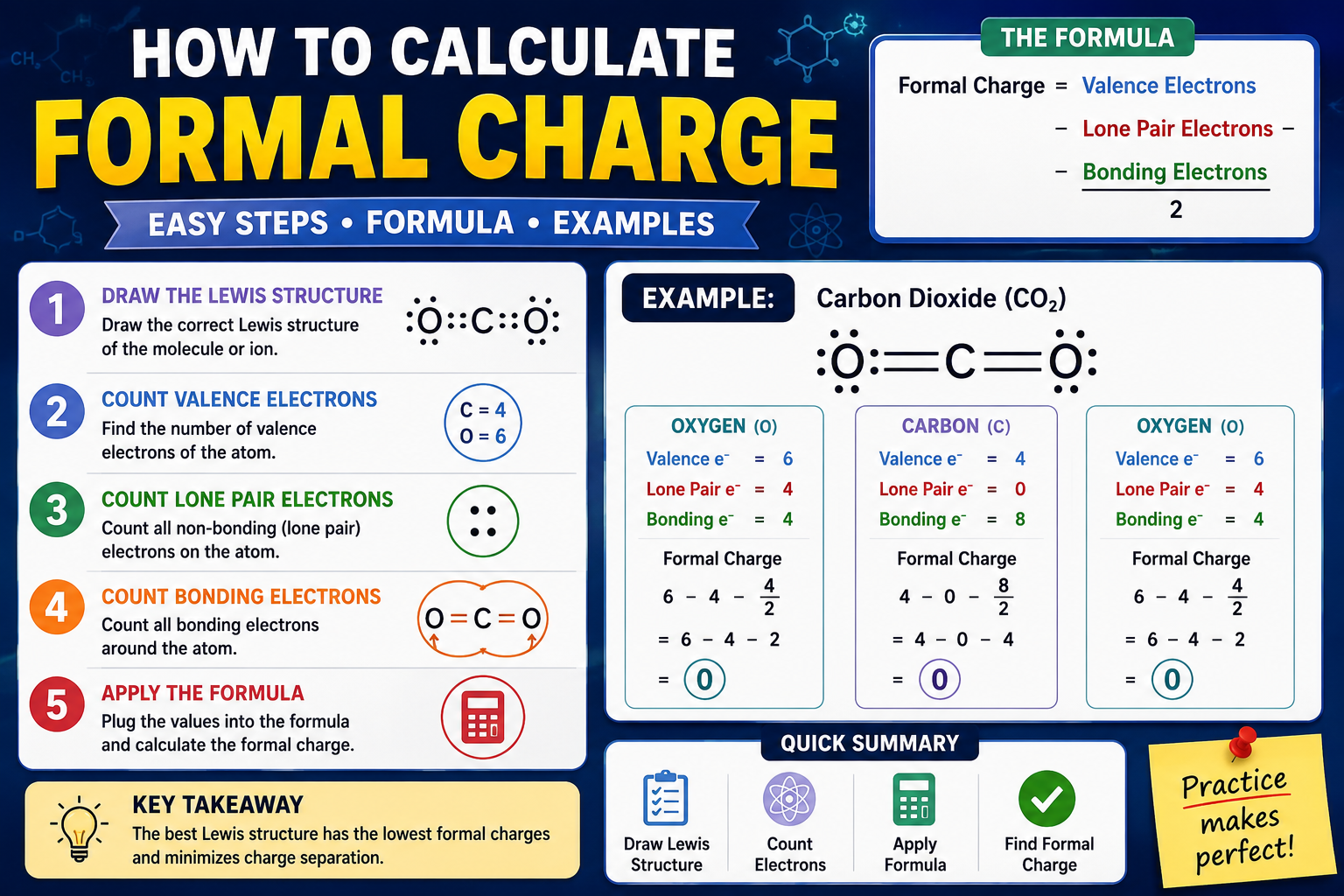
How to Calculate Formal Charge
Understanding how to calculate formal charge is important in chemistry because formal charge helps students identify the most stable Lewis structure of a molecule. Many chemistry students learn this concept while studying chemical bonding, resonance structures, and molecular stability.
Formal charge shows whether atoms in a molecule carry extra positive or negative charge after bonding. Chemists use formal charge calculations to predict how electrons are distributed inside molecules.
Many students find formal charge confusing at first. However, once the formula and process become clear, the calculation becomes simple. Learning how to calculate formal charge helps students improve performance in chemistry exams and laboratory work.
Formal charge does not represent the actual electrical charge of an atom in every situation. Instead, it is a theoretical method used to compare structures and determine the most stable arrangement of electrons.
Students often calculate formal charge when drawing Lewis structures for molecules and ions. Correct formal charge calculations help identify whether the structure follows proper bonding rules.
The process mainly involves counting valence electrons, bonding electrons, and lone pair electrons. After these values are known, the formula becomes easy to apply.
Many chemistry teachers recommend practicing several examples because repetition improves understanding quickly. Once students understand the pattern, calculating formal charge becomes much easier.
Learning how to calculate formal charge also improves understanding of molecular geometry, resonance, and chemical reactions.
What Is Formal Charge?
Before learning how to calculate formal charge, students should understand what formal charge means in chemistry.
Formal charge is the difference between the number of valence electrons in a free atom and the number of electrons assigned to that atom inside a molecule.
Chemists use formal charge to determine which Lewis structure is most stable. The structure with the lowest formal charges is usually the preferred structure.
Formal charge also helps explain electron movement during chemical reactions. Atoms with negative formal charges often attract positive species, while positive formal charges may attract electrons.
Here is a simple formal charge concept table:
| Term | Meaning |
| Valence Electrons | Outer shell electrons |
| Bonding Electrons | Electrons shared in bonds |
| Lone Pair Electrons | Unshared electrons |
| Formal Charge | Assigned charge on an atom |
Formal charge is different from oxidation number. Oxidation numbers focus on electron transfer, while formal charge focuses on electron sharing within bonds.
Students commonly use formal charge while studying molecules like nitrate, sulfate, carbon dioxide, and ammonium ions.
Many molecules contain resonance structures. Formal charge helps identify which resonance form contributes most to the actual structure.
Understanding formal charge improves chemistry problem-solving because it connects electron distribution with molecular stability.
Once students understand the meaning of formal charge, learning how to calculate formal charge becomes much easier.
Formula for How to Calculate Formal Charge
The most important step in learning how to calculate formal charge is understanding the formula.
The formal charge formula is:
\text{Formal Charge} = \text{Valence Electrons} – \text{Lone Pair Electrons} – \frac{\text{Bonding Electrons}}{2}
This formula may look difficult at first, but each part is simple once explained carefully.
Valence electrons are the electrons in the outer shell of an atom. These electrons participate in chemical bonding.
Lone pair electrons are electrons that belong only to one atom and are not shared in bonds.
Bonding electrons are shared between atoms in chemical bonds. Because the electrons are shared equally in formal charge calculations, students divide bonding electrons by two.
Here is a simple breakdown table:
| Formula Part | Explanation |
| Valence Electrons | Electrons in free atom |
| Lone Pair Electrons | Nonbonding electrons |
| Bonding Electrons ÷ 2 | Shared bond electrons |
Students should always count electrons carefully before using the formula. Incorrect counting creates wrong formal charges.
Most chemistry students memorize the formula because it appears frequently in exams and assignments.
The formula becomes easier after practicing examples regularly. Repetition improves speed and accuracy significantly.
Understanding this formula is the foundation of learning how to calculate formal charge correctly.
Step-by-Step Process for How to Calculate Formal Charge
Students learning how to calculate formal charge should follow a clear step-by-step process. This method reduces mistakes and improves understanding.
The first step is drawing the Lewis structure correctly. Students must show all bonds and lone pair electrons clearly.
The second step is identifying the atom for formal charge calculation. Each atom inside the molecule may have a different formal charge.
The third step is counting valence electrons for the selected atom. Students can use the periodic table for this information.
The fourth step is counting lone pair electrons around the atom. These electrons belong completely to that atom.
The fifth step is counting bonding electrons connected to the atom. Shared electrons are divided equally between bonded atoms.
Finally, students apply the formal charge formula carefully.
Here is a simple process table:
| Step | Action |
| Step 1 | Draw Lewis structure |
| Step 2 | Select atom |
| Step 3 | Count valence electrons |
| Step 4 | Count lone pair electrons |
| Step 5 | Count bonding electrons |
| Step 6 | Apply formula |
Students should calculate formal charges for every atom in the molecule. The total formal charges should match the overall molecular charge.
Practice is very important while learning how to calculate formal charge. Students who solve many examples usually understand the concept faster.
Checking calculations carefully also reduces errors. Small counting mistakes often create incorrect answers.
Using a systematic process makes formal charge calculations easier and more accurate.
Example of How to Calculate Formal Charge
An example helps students understand how to calculate formal charge more clearly. One common example is ammonia (NH₃).
Nitrogen has 5 valence electrons. In ammonia, nitrogen forms three single bonds with hydrogen atoms and keeps one lone pair.
The calculation becomes:
- Valence electrons = 5
- Lone pair electrons = 2
- Bonding electrons = 6
Applying the formula:
5 – 2 – \frac{6}{2} = 0
The formal charge on nitrogen is 0.
Now consider one hydrogen atom:
- Valence electrons = 1
- Lone pair electrons = 0
- Bonding electrons = 2
The calculation becomes:
1 – 0 – \frac{2}{2} = 0
Each hydrogen also has a formal charge of 0.
Here is a summary table:
| Atom | Formal Charge |
| Nitrogen | 0 |
| Hydrogen | 0 |
Because all atoms have zero formal charge, ammonia is considered stable.
Examples like this help students understand how bonding and lone pairs affect electron distribution.
Practicing several examples is one of the best ways to master how to calculate formal charge.
Importance of Learning How to Calculate Formal Charge
Understanding how to calculate formal charge is very important in chemistry because formal charge helps predict molecular stability and chemical behavior.
Chemists use formal charge to compare different Lewis structures. The most stable structure usually has the smallest formal charges.
Formal charge also helps explain resonance structures. Some molecules can exist in multiple bonding arrangements. Formal charge helps determine which arrangement contributes most strongly.
Students studying organic chemistry also use formal charge frequently. Reaction mechanisms often involve positively or negatively charged atoms.
Formal charge calculations improve understanding of molecular geometry as well. Electron distribution affects molecular shape and polarity.
Many chemistry exams include formal charge questions because the concept connects several important topics together.
Formal charge also supports understanding of acids, bases, and electron movement during reactions.
Scientists use formal charge concepts while studying complex molecules, ions, and reaction intermediates.
Students who understand how to calculate formal charge often perform better in advanced chemistry courses because they understand electron behavior more clearly.
Although the process may seem difficult initially, regular practice makes the calculations much easier.
Learning how to calculate formal charge builds a strong foundation for future chemistry studies.
Common Mistakes While Learning How to Calculate Formal Charge
Students learning how to calculate formal charge often make a few common mistakes. Understanding these mistakes helps improve accuracy.
One common mistake is counting bonding electrons incorrectly. Students sometimes forget to divide shared electrons by two.
Another mistake involves counting lone pair electrons improperly. Lone pair electrons belong completely to one atom and should not be shared.
Some students also confuse formal charge with oxidation number. These concepts are different and use different calculation methods.
Incorrect Lewis structures create problems as well. Students should always draw the molecule correctly before calculating formal charge.
Here is a simple mistake table:
| Common Mistake | Problem Created |
| Wrong electron count | Incorrect formal charge |
| Forgetting bond division | Overestimated charge |
| Incorrect Lewis structure | Wrong calculations |
| Confusing oxidation numbers | Chemistry confusion |
Students should also check total molecular charge after calculations. The sum of formal charges should equal the molecule’s overall charge.
Rushing through calculations often increases mistakes. Careful counting improves accuracy significantly.
Practice helps students avoid these errors over time. Repetition builds confidence and improves calculation speed.
Understanding these common mistakes makes learning how to calculate formal charge much easier.
Tips to Master How to Calculate Formal Charge
Students can improve their understanding of how to calculate formal charge by using smart study strategies.
The first tip is memorizing the formula completely. Knowing the formula reduces confusion during problem-solving.
Students should also practice drawing Lewis structures regularly. Strong Lewis structure skills improve formal charge calculations automatically.
Using the periodic table carefully also helps because valence electron counts are very important.
Solving practice problems daily improves speed and confidence. Simple repetition strengthens chemistry skills over time.
Students should also review incorrect answers carefully. Understanding mistakes improves future performance more effectively than guessing.
Color-coding lone pairs and bonding electrons sometimes helps visual learners understand electron distribution more clearly.
Group study sessions can also improve understanding because students explain concepts to each other.
Watching chemistry diagrams and examples helps many students understand electron movement visually.
Teachers often recommend practicing resonance structures because they involve multiple formal charge calculations.
Consistent practice and careful counting are the best ways to master how to calculate formal charge successfully.
FAQs About How to Calculate Formal Charge
What is formal charge in chemistry?
Formal charge is the assigned charge on an atom inside a molecule based on electron distribution.
Why is formal charge important?
Formal charge helps determine the most stable Lewis structure and explains electron distribution in molecules.
What formula is used to calculate formal charge?
The formula is:
Valence Electrons − Lone Pair Electrons − Bonding Electrons ÷ 2
Can formal charge be negative?
Yes, formal charge can be positive, negative, or zero depending on electron distribution.
Is formal charge the same as oxidation number?
No, formal charge and oxidation number are different concepts used for different chemistry purposes.
Conclusion
Learning how to calculate formal charge is an important skill in chemistry because it helps students understand molecular stability, bonding, and electron distribution.
Formal charge calculations become simple once students understand valence electrons, lone pairs, and bonding electrons clearly. Using the formula carefully helps identify the most stable Lewis structures.
Students should practice multiple examples regularly because repetition improves both speed and accuracy. Correct Lewis structures and careful electron counting are very important for success.
Understanding how to calculate formal charge also supports learning in advanced chemistry topics such as resonance, reaction mechanisms, and molecular geometry.
With regular practice and careful study, students can master formal charge calculations and build stronger chemistry knowledge overall.